Showing posts with label beneficial insects. Show all posts

Saturday, 8 August 2015

Bee Hotel Workshop a Great Success!

Thanks a lot to everyone who came along to our bee hotel workshop, and everyone who donated materials - you all helped make the workshop a great success!

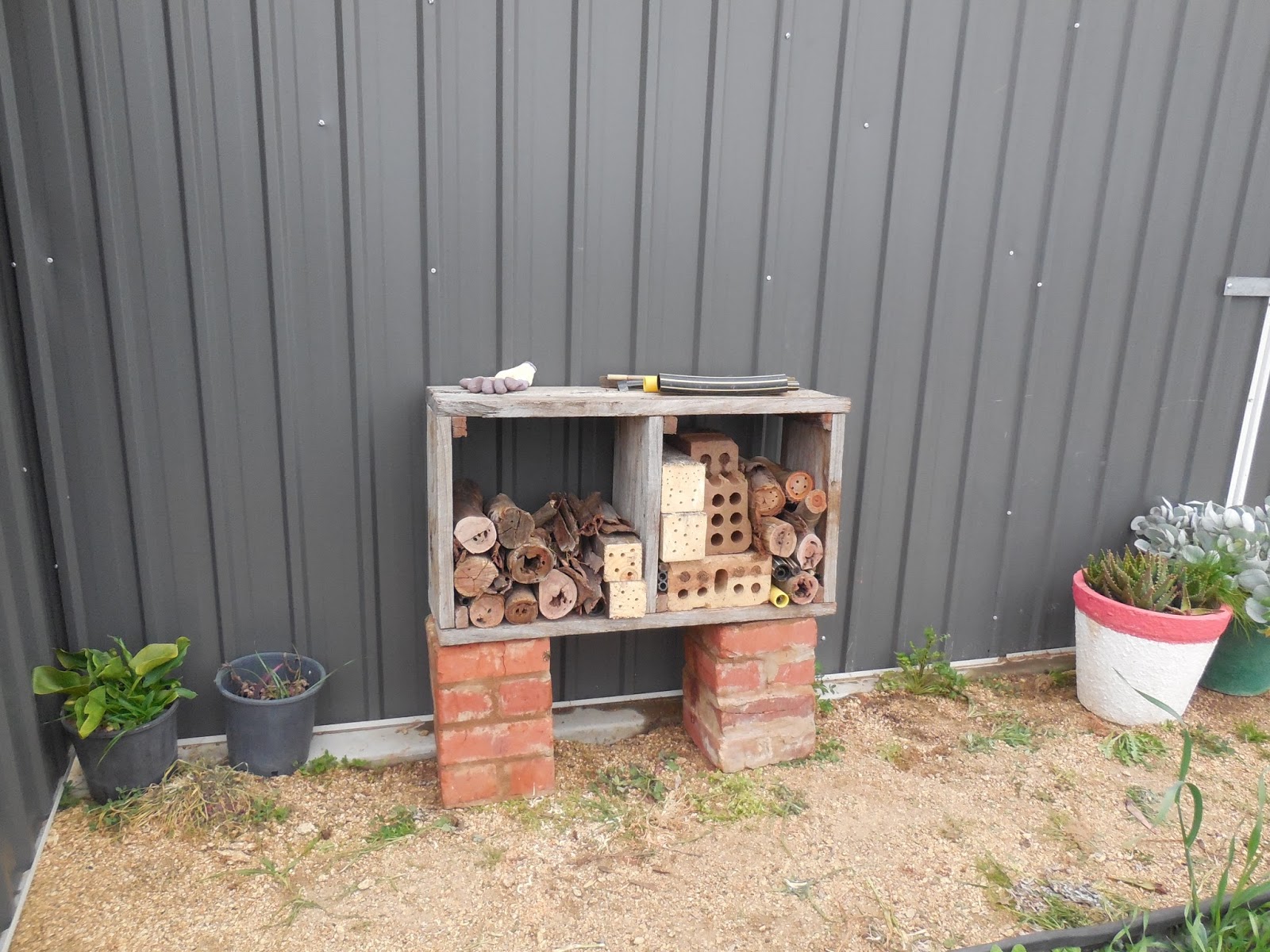
Despite the cold, wet, grey weather we had a total of 13 attendees, including five children, and everyone had fun selecting just the right bits and pieces and assembling them in just the right order to make a total of eight differently sized and shaped bee hotels - including one for the Food Gardens, that is now set up beside the shed, so be sure to check it out next time you're gardening!

The new bee hotel at the Food Garden under construction

Read on for more photos.

Saturday, 25 July 2015

Of bees, hotels and permaculture gardening

Where would gardeners be without bees? Probably down on our knees with little horse-hair brushes, or busy planting species that attract hoverflies and other pollinators. But many plants are selective about which insect species they’ll share pollen with, and who has time to hand-pollinate an entire garden these days?

Sometimes you just need bees.

Most of us, when we think of bees, think of the introduced European honeybee Apis mellifera, but Australia is also home to around 1500 species of native bees. Some, like the stingless bee Tetragonula carbonaria, form hives and produce honey, but most Australian bees are solitary and nest either in the ground or in small gaps and hollows in timber and stone. All bees are pollinators, although some are able to pollinate a wider variety of plant species than others; some species, like the native blue banded bee (Amegilla cingulata) I spotted up at the gardens earlier this year, are particularly valuable pollinators for food crops, and are a boon to gardeners and farmers alike.

So how can we attract more of these oh-so-helpful solitary bees into our gardens? By building them a hotel of course.

Monday, 20 July 2015

Upcoming Workshop - Making Bee Hotels


Join us up at the gardens on August 1st to make your very own bee hotels to take home (1 per household) - and one for the Narrandera Food Garden!

Places are limited, so please RSVP to a committee member, either by phone or via Facebook. Places are 'per household' so that could be one person, a couple, or a family group, so feel free to come by yourself or bring your partner and kids (or grandma!) along. However, having dogs underfoot could be dangerous, so no pets please.

$15 per 'household', all materials will be provided, and you will get to take your bee hotel home at the end of the day.

We encourage everyone to bring along a picnic lunch, and to stay as long as you like after finishing your hotel.

If anyone would like to sign up to become a garden member on the day, there will be forms available for you to do so.

Keep an eye on this blog for more information about bee hotels in the near future.

We look forward to seeing you there!


Wednesday, 13 May 2015

Beneficial Insects in the Narrandera Food Garden

Hi all, Kimberley here. I recently attended a workshop on Beneficial Insects and thought you all might be interested in learning a bit about them too.

Read on to find out why I was excited to see this guy


At the Narrandera Food Garden we are trying to adopt permaculture principles into our gardening practices. Permaculture is all about working with nature to achieve an end goal that is beneficial for all. This means trying to encourage natural pollinators and pest control agents, rather than poisoning our environment, ourselves, and all those ‘good’ bugs (and the things that eat them!) out there by using pesticides and herbicides.

We live in a very chemical-based society, and it’s so easy to get caught up in thinking that we have to use pesticides and herbicides all the time to get rid of weeds and pests. However, this over-reliance on chemical controls has been proven to result in not only the loss of plants, insects and animals that can help us control the ‘bad guys’ but also to create environments that encourage weed growth and pest attacks (invasive weeds are the first to encroach on bare ground after weed spraying, due to the lack of competition; and loss of predatory insects, due to broad-scale pesticide use, can give the pest species that emerge later free reign). Agricultural scientists are also finding that weed and pest species are developing resistances to commonly-used pesticides and herbicides, making them less effective, and forcing chemical control companies to develop ever more potent poisons. The end result of this cycle is a higher and higher reliance on chemical controls as we steadily remove harmless and beneficial species from our gardens and crops, and more and more chemicals going on and into our food, soil, water and air. The only winners in this cycle are the chemical companies.